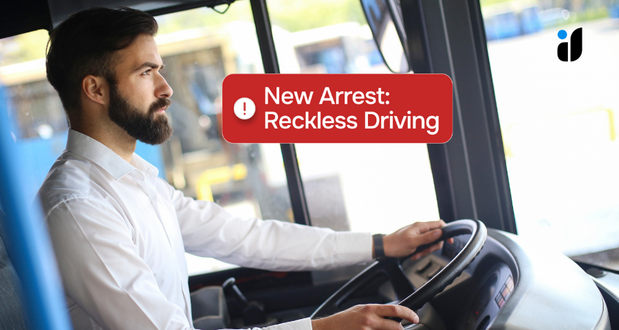
A while back, I learned that my vehicle registration in California had been suspended.
The reason wasn’t particularly dramatic. I had missed a letter about an unpaid toll. I wasn’t deliberately ignoring the problem or trying to get around the rules. I simply hadn’t seen the notice.
But the result was the same: I was driving a vehicle I technically shouldn’t have been driving.
I think about that experience when people talk about driver monitoring, because the conversation tends to go quickly to serious violations and risky drivers. And those situations certainly matter. But not every driver-risk issue begins with bad intent, and not every alert needs to end with a punitive response.
Sometimes, knowing sooner simply gives you more time to do something useful. That, to me, is one of the most overlooked benefits of continuous driver monitoring.
The visibility gap can also be an intervention window
Traditional point-in-time screening establishes an important baseline. But the person continues driving after the initial check.
A new event can occur, move through the court system, and eventually make its way into the records an employer routinely reviews. Depending on the event and jurisdiction, that process can take time.
Consider something as ordinary as a speeding ticket with a court date attached. A driver spends much of the week on the road. A notice gets missed. A court obligation goes unattended. What began as a manageable traffic matter progresses and, depending on the circumstances and jurisdiction, can eventually contribute to a licensing problem.
We often talk about the period before that problem becomes visible through a later record check as a visibility gap. I think there is another way to look at it: it can also be an intervention window.
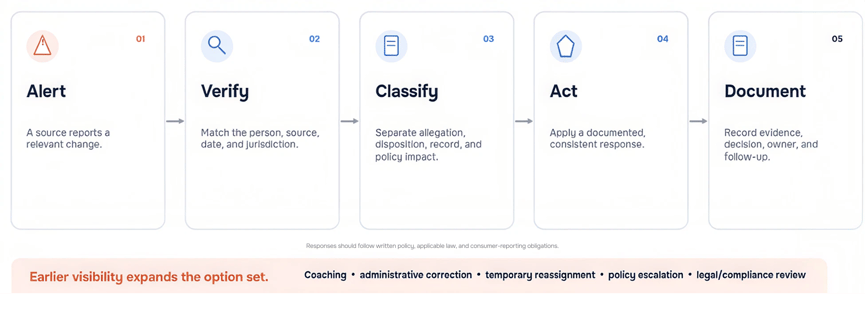
If an employer learns about the issue early enough, there may be an opportunity to remind the driver about an upcoming court date, provide training, or recognize a developing pattern that warrants attention under the organization’s policies. But if the issue isn’t discovered until it becomes a documented licensing problem, the available options may be narrower.
The appropriate response will always depend on the circumstances. Sometimes it may mean taking a driver off the road. But driver monitoring isn’t inherently a firing tool. Its real value is time.
Safety and retention don’t always have to compete
That time can matter to the business as well as the driver.
Anyone who works around commercial drivers knows how difficult qualified drivers can be to find and retain. When a driver unexpectedly loses the ability to work, routes may need to be reassigned, vehicles can sit unused, and schedules change.
Managing risk and retaining qualified drivers can therefore look like competing priorities. But they aren’t inherently at odds. The objective is to identify meaningful changes early enough to make an informed decision about what happens next. When an issue can be addressed appropriately before it becomes more serious, safety and retention can sometimes be served by the same action.
More alerts aren’t the same as more visibility
Earlier information, however, is only valuable if organizations can make sense of it.
A monitoring program that generates a constant stream of undifferentiated alerts can replace one problem with another. If everything demands attention, it becomes harder to know what actually matters.
Severity, frequency, and recency can provide important context. One event may warrant a very different response from a developing pattern of similar events over a short period. Organizations also need to determine which events matter based on their own policies, drivers, and risk profile.
The goal is to surface meaningful changes with enough context to prioritize what deserves attention, not to simply monitor everything. That suggests a different way to evaluate a monitoring program: instead of asking how many alerts it generates, ask what those alerts allow you to do:
- Did you learn about an issue before an annual review or insurance renewal made it a surprise?
- Did the information help you focus attention on the drivers and events that warranted it most?
- Most importantly, did it arrive while there was still an opportunity to respond?
Those outcomes tell you much more than alert volume ever could.
Risk doesn’t stand still after a background check or MVR is completed. The question is whether meaningful changes become visible while there's still an opportunity to respond.
Sometimes the most valuable risk information is the information that reaches you while there is still something useful you can do about it.
For a closer look at these issues, watch my recent conversation with ARCpoint Labs on driver risk, gaps in point-in-time screening, and continuous visibility. Watch the full webinar →