
Four violations. Four jurisdictions. Forty days.
That’s what we found when we looked at the activity of one commercial driver in a recent analysis. The driver lived in California, and if an employer had looked only at the California activity, it might have seen an overweight violation. Worth considering, certainly, but not necessarily something that would change the overall assessment of the driver.
The broader picture looked much different.
Over those same 40 days, the driver had cited violations across four jurisdictions, including two similar traffic-control violations just days apart. Viewed individually, each record told us something about a single event. Connected to the same person, they revealed a pattern.
That context matters. One violation can mean something very different from several similar violations in a short period. Severity matters, but so do frequency and recency.
That gets to the heart of one of the hardest challenges in driver risk today: a record can be accurate without giving you a complete picture of the person behind it.
Drivers cross borders. Their records don’t always follow.
Commercial drivers routinely cross state and jurisdictional lines as part of their jobs. The information created along the way can remain distributed across court systems, motor vehicle records, federal sources, and other databases, each built to serve a particular purpose.
As a result, relevant activity outside a driver’s home state may not appear in the source an employer routinely reviews. Individual records can be accurate while still reflecting only a portion of a driver’s activity. Recognizing those gaps is essential to understanding the full picture.
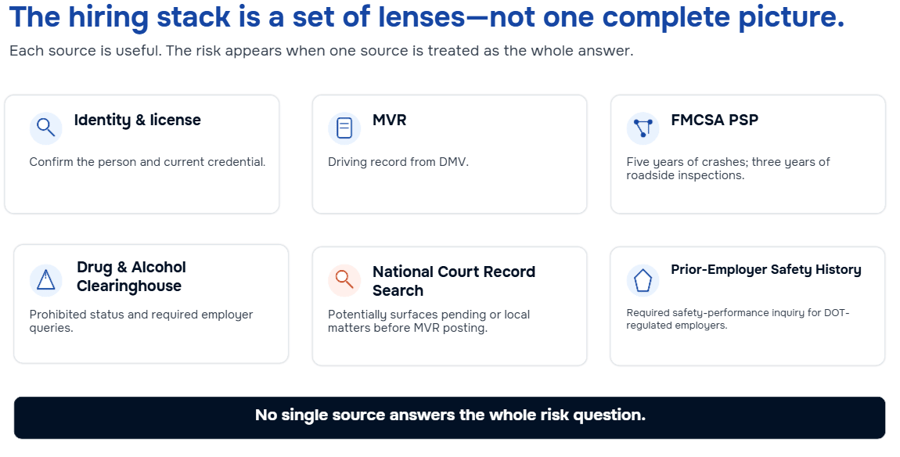
For employers, this means understanding what each source can reveal and where additional context may be needed. A home-state driving record may answer one set of questions, while court records and other sources provide a broader view. Employers need to evaluate whether the information available provides sufficient context to support the decision at hand.
A point-in-time check can be right and still become incomplete
Geography isn’t the only source of visibility gaps. Time creates them, too.
Motor vehicle records remain an important part of driver screening and compliance, but an MVR reflects the information available at the time it is pulled. A new citation can occur, a court case can begin, or a license or registration status can change after that check.
There can also be a delay between when an event occurs and when it appears on a driving record.
Consider a DUI as an example. An incident may begin with an arrest, move into the court system, proceed through hearings and disposition, and eventually reach the driving record. Depending on the circumstances and jurisdiction, those stages can unfold over months.
Now add an annual MVR review to that timeline. An employer could pull a record shortly before new information appears, then wait many months before checking again.
Nothing about that means the original MVR was wrong. A point-in-time record answers a point-in-time question. The harder question is what happens after that point.
A clean record is a starting point, not the whole story
None of this means employers should assume that something is hiding behind every clean driving record. Nor does it diminish the value of established screening and compliance practices.
It means we need to be precise about what those practices can tell us, and where their visibility ends.
For organizations responsible for driver safety and risk, that leads to a few useful questions:
- Are we relying on one source to tell us something it was never designed to tell us?
- Can we identify relevant activity across jurisdictions and connect it to the right person?
- Do we have a way to understand meaningful changes between scheduled checks?
Together, these questions point to a broader consideration: whether an organization has the information and visibility needed to make informed decisions about driver risk.
Ultimately, those decisions affect people. Having an accurate, well-rounded understanding of each individual is essential.
For a closer look at these challenges, watch my recent conversation with ARCpoint Labs on driver risk, gaps in point-in-time screening, and continuous visibility. Watch the full webinar →