AI and technology are making it possible to automate more of the background screening process, but some information still requires someone to go directly to the source.
Court research is a good example. While many records can be accessed electronically, there are still situations where a researcher needs to physically go to a courthouse, navigate its systems, locate the appropriate record, and determine whether what they found matches the search they were asked to complete.
The need for that expertise does not mean the process surrounding it has to remain unchanged. Some of the most meaningful opportunities for technology can be found by looking closely at the work people still need to do and identifying the friction that makes that work harder, slower, or more manual than it needs to be.
Looking Beyond the Courthouse Search
For a court researcher, retrieving the record is only part of the job. The information they find also needs to be captured accurately, reviewed, and returned so that the order can continue through the screening process.
As volume and complexity increase, that work can become a meaningful constraint. A researcher working through hundreds of orders may encounter records with multiple cases, charges, and dispositions. A particularly complex record can require significant data entry, while something as ordinary as traffic or an unreadable photograph can delay information that has already been retrieved.
At scale, those operational details can affect both turnaround time and the amount of work a researcher can reasonably complete in a day. They also raise a practical question: where could some of that friction be removed?
Designing Around the Work
That question shaped InformData's approach to improving conventional court research.
The team worked with operations and field researchers to understand where time was being spent and what was getting in the way. What prevented a result from moving forward while the researcher was still at the courthouse? Which tasks depended on the researcher's knowledge, and which existed because of how information traditionally moved through the process?
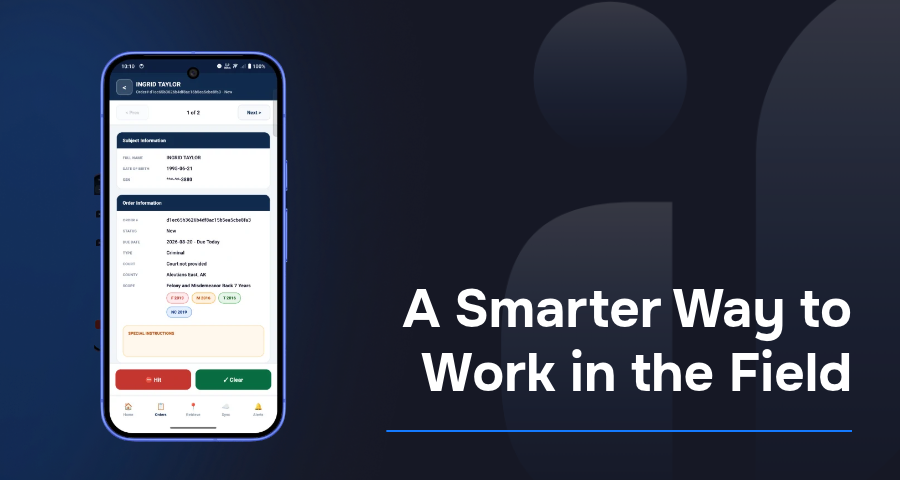
What emerged was an opportunity to move more of the workflow into the courthouse itself, which led to the development of CourtCollect. This mobile app enables researchers to manage assigned orders, capture court information, and review the information extracted while they are still there. They can confirm what was captured, make corrections when necessary, and submit completed work directly into InformData's system.
Early results from the field pilot have shown response speeds improving by up to 50% as information can move forward without waiting for the additional processing that traditionally happened after researchers left the courthouse.
What This Looks Like in the Field
The impact becomes more tangible when you see the workflow in the environment where it actually happens.
During the pilot, we spent time with one of our court researchers as he used CourtCollect in a Massachusetts courthouse. Researchers may be working at public terminals, capturing information through glass or from court screens, moving through multiple records, and working around other people who need access to the same systems. Designing for that environment requires understanding not only the information being collected, but how the work actually gets done.
For this researcher, one of the clearest differences was the time required to process a complex record. He described one example that had previously taken about 40 minutes to enter manually. Using the new workflow, he was able to capture and process the same information in about five minutes.
The change also gave him more flexibility in how he used his day. Instead of leaving the courthouse early enough to get home and enter the information he had collected, he could spend more of that time completing searches in the field because the results were already being submitted as he worked.
Start With the Friction, Not the Technology
Court research is one example of a broader opportunity in background screening.
As AI, automation, and other technologies become more capable, it is natural to focus on what else can be automated. But some of the most valuable opportunities may come from looking at established processes differently and identifying the friction that no longer needs to be there.
That requires understanding where expertise matters, where unnecessary effort has accumulated and where technology can create meaningful change without disrupting what already works.
Sometimes the opportunity is not to replace the work, but to make the process around it work better.